


How advancing technology is continuing to transform modern neurosurgery
By Admin | December 11, 2025
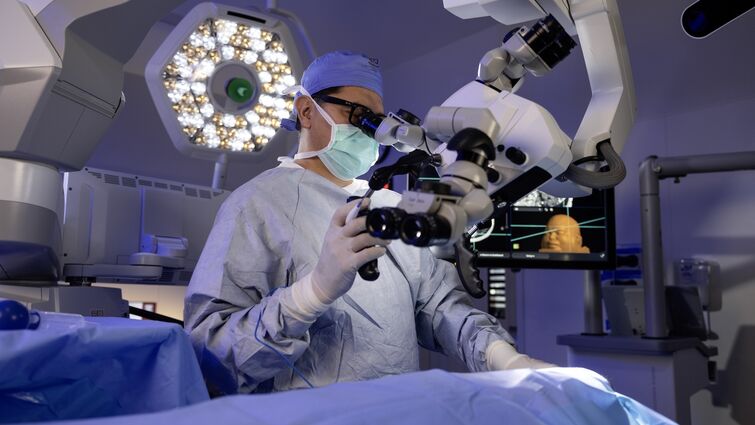
Dr. Lopez-Gonzalez looking through an operating microscope with neuronavigation/image guidance system in background.
Neurosurgery, which encompasses surgeries of the brain, spine, and peripheral nerves, has evolved dramatically over the past century due to rapid progress in imaging, navigation, robotics, and computational power.
While neurosurgeons have tools that allow them to perform safer, more precise, and less invasive procedures than ever before, it wasn’t always like that.
Warren Boling, MD, Chair of Neurosurgery at Loma Linda University Health, explains how modern neurosurgery has become one of the most technologically driven fields in all medicine through years of medical innovation.
The foundations: how imaging changed everything
Early neurosurgeons had only crude imaging tools to approximate where abnormalities in the brain might lie. One of the first major breakthroughs came in the early 20th century with the pneumoencephalogram –– a procedure where air was injected into the spinal fluid with a lumbar puncture, which would create a negative contrast effect on skull X-ray to outline the brain and visualize surface abnormalities.
Another pivotal development came from a Portuguese neurologist who discovered cerebral angiography in the 1920s–– injecting contrast dye into the carotid artery to see shifts in blood vessels caused by tumors or stroke on a skull X-ray.
For many decades, these tools were the only imaging modalities available for the brain, with angiography still an important tool used in modern medicine.
CT and MRI: precision when it truly matters
Technology took a dramatic leap for neurosurgery with the inventions of the CT scan and the MRI.
The invention of the CT scan in the 1970s by the British company EMI used X-rays combined with early generation computers that had integrated recent advances in silicon chip and...(More)
For more info please read, How advancing technology is continuing to transform modern neurosurgery, by Loma Linda University Health