

Make the No Surprises Act Enforceable
By Laura Trotter | September 16, 2026
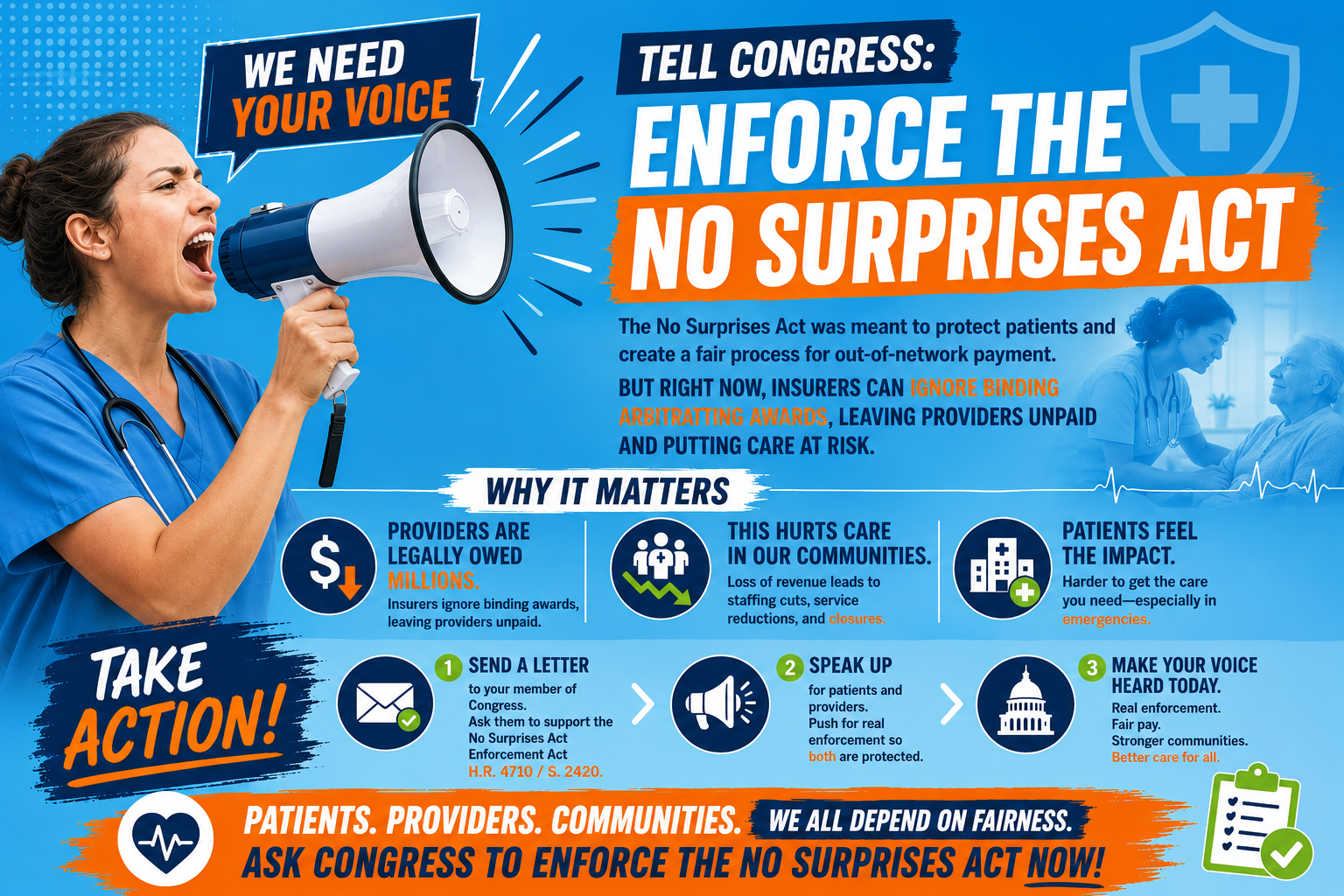
Support H.R. 4317, the No Surprises Act Enforcement Act
The No Surprises Act achieved an important goal: protecting patients from unexpected out-of-network medical bills. It also created a neutral process for resolving payment disputes between healthcare providers and health plans.
That process cannot work as Congress intended unless its decisions are followed.
Providers across the country continue to report late payments, incomplete payments, post-payment recoupments, and outright nonpayment after prevailing in federal Independent Dispute Resolution. Based on reports from provider practices and arbitration organizations, payment problems may affect approximately 20% to 50% of favorable awards, depending on the practice and payer.
These provider-reported experiences are not a substitute for comprehensive federal data. They demonstrate why federal payment reporting and enforcement are urgently needed.
Nearly Half of Awards in One Major Survey Were Not Paid on Time
The Emergency Department Practice Management Association surveyed nine organizations representing hundreds of emergency-medicine practices about their 2025 IDR experience.
Respondents reported that:
- 48% of favorable IDR determinations were not paid within the required 30-day period.
- Paid awards took an average of 67 days from the determination to receipt of payment.
- Approximately $245 million remained unpaid at the end of 2025.
- Health plans submitted approximately 24,300 zero-dollar final offers during the year.
This survey examined emergency-medicine organizations rather than IONM providers, but its findings are consistent with payment problems reported across other out-of-network specialties.
Review the EDPMA payment-compliance report
A Binding Determination Should End the Dispute
Federal rules already require any amount due after an IDR determination to be paid within 30 calendar days.
Providers have fulfilled their clinical responsibilities, completed open negotiation, paid administrative and arbitration fees, presented their evidence, and waited for a certified IDR entity to issue a decision. The prevailing party should not have to begin another lengthy process simply to collect the amount awarded.
H.R. 4317 would strengthen the existing payment deadline through penalties, interest, payment notification, and more transparent enforcement reporting. Its accountability provisions apply to both sides.
The legislation does not guarantee that providers will win. It makes the final result meaningful, regardless of which party prevails.
Providers Would Prefer Fair Settlements
IDR is not an easy or inexpensive path to payment. It requires specialized staff, filing fees, documentation, legal and administrative support, and long-term tracking of unresolved claims.
Federal data show that only 37% of payment determinations issued during the first half of 2025 were completed within 30 business days. Approximately 67% were completed within 60 business days.
Providers would generally prefer to resolve claims during open negotiation. That becomes difficult when plans or their administrators make nominal offers, provide incomplete information, or decline to discuss a reasonable settlement.
Some providers have received offers as low as $1 for specialized services. A procedural open-negotiation period is not meaningful when one party has little incentive to negotiate.
Review the CMS federal IDR report
QPA Transparency Matters
The Qualifying Payment Amount is generally based on a plan's median contracted rate for the same or similar service in a geographic area, adjusted under federal rules.
Providers ordinarily cannot inspect the contracts or underlying data used to calculate it. This makes it difficult to determine whether the QPA reflects:
- Comparable services and clinical settings.
- Active, regularly used contract rates.
- The duration and complexity of the service.
- Appropriate geographic information.
- Nominal rates that may exist in contracts but are rarely or never used.
This issue is particularly important for IONM. Some of the modalities used during surgery are also used in shorter diagnostic settings. Continuous multimodal monitoring during a complex neurological or spine procedure may require hours of specialized clinical coverage and cannot be evaluated as though it were a brief office-based diagnostic study.
Congress and federal regulators should require auditable QPA methodologies while protecting legitimate contractual information.
Ineligible Claims Are a Process Problem Not Proof of Widespread Fraud
Payers frequently cite ineligible disputes as evidence that providers are abusing IDR. The federal data present a more complete picture.
CMS reports that the percentage of disputes found ineligible declined from 69% during the first half of 2022 to 17% during the first half of 2025.
That progress suggests that clearer rules, better information, improved screening, and increased experience with the process are working.
Eligibility errors can occur when providers cannot determine:
- Whether a plan is fully insured or self-funded.
- Which entity is legally responsible for the claim.
- Whether federal or state dispute resolution applies.
- Which payer or administrator should receive the notice.
- Whether an EOB contains complete and accurate plan information.
Plans and administrators possess much of this information. Standardized disclosures and accurate plan identification can prevent many ineligible filings before they occur.
Intentional abuse by any party should have consequences. Administrative errors caused by incomplete or confusing payer information should be corrected through transparency and better system design.
Why Enforcement Matters for IONM
Intraoperative neuromonitoring helps surgical teams detect neurological compromise while there may still be time to intervene. It is used during high-risk spine, brain, vascular, and other procedures where changes in neurological function can have life-altering consequences.
IONM is resource-intensive. A multimodal case may require a credentialed surgical neurophysiologist, specialized equipment, continuous monitoring, physician interpretation, clinical oversight, credentialing, and substantial professional liability coverage. The direct incremental cost of delivering a typical multimodal service frequently exceeds $1,500, before the broader overhead required to operate a compliant clinical practice.
Consistent underpayment - and failure to pay final IDR awards - places independent IONM practices under significant financial pressure. Smaller organizations are particularly vulnerable because they have fewer resources available to finance years of disputed receivables.
Patients may be protected from receiving the bill, but they are not protected from losing access to the service if qualified providers can no longer afford to furnish it.
Why Rate Caps Are the Wrong Solution
A rate cap based on the QPA or another rigid benchmark would reduce the incentive for plans to negotiate meaningful network contracts or make reasonable initial payments.
It could also produce distorted results in specialties where available codes or contracted rates do not adequately distinguish among clinical settings, duration, staffing, and complexity.
The existing final-offer process allows both parties to submit an offer and supporting evidence to an independent decision-maker. Congress should improve transparency and compliance before replacing that process with a payment ceiling.
Appropriate safeguards can address clearly improper claims or extreme offers without making a nontransparent payer-calculated benchmark determinative in every case.
About Axis Neuromonitoring
Axis Neuromonitoring is a patient-first, employee-owned organization committed to protecting patients during complex surgical procedures.
Our employees have a direct stake in the quality, integrity, and long-term sustainability of the care we provide. We follow responsible practices throughout the clinical and reimbursement process, including:
- Employing qualified and appropriately credentialed clinical professionals.
- Maintaining physician oversight and clinical quality standards.
- Supporting medical necessity and accurate documentation.
- Submitting compliant claims.
- Attempting to resolve payment disputes through open negotiation.
- Verifying claim eligibility before initiating IDR.
- Avoiding arbitration when the initial payment is reasonable.
- Supporting accountability for intentional abuse by either party.
We believe the No Surprises Act can protect patients while supporting fair, sustainable access to specialized care. Achieving both goals requires a process that is transparent, balanced, and enforceable.
What Congress Should Do
We urge Congress to:
- Pass H.R. 4317, the No Surprises Act Enforcement Act.
- Enforce the existing 30-day payment deadline.
- Require payment notification and transparent enforcement reporting.
- Improve plan, funding-source, and QPA disclosures.
- Preserve independent, case-specific review without arbitrary rate caps.
- Hold plans, administrators, providers, and facilities accountable for intentional noncompliance.
The No Surprises Act established the rules. The next step is ensuring that every party follows them.
